Tuesday, 10 June 2014

Sources Of Inspiration


“Creativity involves breaking out of established patterns in order to look at things in a different way.”- Edward De Bono
This quote very beautifully expresses that without change there is no innovation or scope for improvement. To bring about this change one needs to be constantly inspired by something new.
Field of jewelry yearns for new unique concepts and designs. To fulfill this requirement a designer needs to draw inspiration from various avenues. Drawing inspiration requires keen observation and analysis of visual information which is collected from various sources that surround us. And this information forms the very base for one’s designs.

There are infinite sources to get inspiration from, but for convenience a few sources are being listed below:

Nature: the word nature is derived from the Latin word natura which in ancient times literally meant “life”. Nature provides us with innumerable ideas and concepts. The array of beautiful colors to birds, insects, flowers, galaxy etc. Every dimension of nature is captivating. An eye of detail is what is required to make the best use of this inexhaustible source. Conclusions drawn prove out to be a good starting point to create designs.
NATURE

History & Art Eras: art eras like Art Nouveau and Art Deco can have strong influences on designing. Even periods like Edwardian and Georgian, Medieval etc. can prove out to be rich sources of inspiration.
The architecture, painting, textiles, sculptures of these periods can provide one with dynamic concepts. Our very own Indian culture is a treasure of such ideas. Scripts of various languages are again an interesting source to work with.
ART DECO
INDIAN CULTURE
ART NOUVEAU

Symbolic sources: a lot of jewelry is designed keeping in mind various symbolic sources like zodiac signs, representative forms of Gods and Goddesses, religious symbols, organizational signs etc. this also includes various geometrical shapes. Creating a slightly different style with these shapes can produce remarkable results. Permutation and combination of these shapes can be a great base for one to work with.

SYMBOLIC SOURCES


Theme or Concept: when a designer is given a particular theme or concept to work upon, inspiration can be taken from various aspects of the provided theme. Recording and analyzing the information collected and incorporating the same in the designs is a healthy practice. Working for a jewelry brand is an inspiration in itself. To create new designs keeping in mind the style of the brand is an interesting exercise and challenge.
Various other sources like books, magazines, art exhibitions, public forums, museums etc can also be really helpful.
There are absolutely no parameters as to what one can get inspired from. An open mind is all it takes to create a spectacular range of jewelry.

Tip: Always maintain a sketch book to record your observations for reference.


 PICTURES ADOPTED FROM GOOGLE

Thursday, 15 May 2014

Stone Settings


This post of ‘Jewel Affair’ will talk about an extremely interesting subject which is stone setting. Stone setting can be described as an art of securely setting gemstones into an ornament. It can be said that it is comparatively easy for a designer to sketch a design, but the real challenge is to bring life to that design. This can be accomplished when one decides what settings will be applied to that design to transform it into an exquisite piece of jewelry.
There are many variations of stone settings but in this post we will be going through the most important and commonly used ones.
 
STONE SETTING RING

Bezel setting:
Bezel is the earliest known technique of stone setting. It can be described as a strip of metal which is bent and fashioned according to the shape and size of the stone. And the girdle or the edge of the stone is seated on this metal strip. The metal extends slightly above the stone and the extended part is pressed over the stone to secure it. This type of setting is most commonly seen in ornaments made for astrological purposes.
A square or a rectangular bezel is often termed as Box setting.
 
BEZEL SETTING
Picture Courtesy: Sri Krishna Diamonds & Jewellery
Prong setting:
In this method a metal socket or a collet is prepared and from this socket the metal is projected. This projection overlaps the edge of the stone and secures it to the setting. Prong setting is the most commonly used setting because it uses the least amount of metal to secure the stone and this reason in return brings out the brilliance of the gemstone a lot more. There are different kinds of prongs made like square, emerald, Navette, and Tiffany. This setting is popularly known as open setting.
 
PRONG SETTING
Picture Courtesy: Sri Krishna Diamonds & Jewellery
Channel setting:
In channel setting the stones are set usually between two metal ridges running parallel to each other. The sides of the mounting grip or hold the outer edges of the stones. And also in between two stones there is no metal present.
 
CHANNEL SETTING
Picture Courtesy: Sri Krishna Diamonds & Jewellery
Bead setting:
In this method of stone setting holes are drilled on a metal base and depressions are formed with the help of a tool according to the size of the stones. And then prongs are made with the help of a beading tool and the stones are pushed in. then the prongs are pressed over the stones for securing them.
 
BEAD SETTING
Picture Courtesy: Sri Krishna Diamonds & Jewellery
Pave` setting:
Pave` is a word of French origin, derived from ‘paver’.  This is a type of bead setting in which as many stones as possible are set very close to each other to show the minimum amount of metal.
 
PAVE` SETTING
Picture Courtesy: Sri Krishna Diamonds & Jewellery
Gypsy /Flush setting:
This is a modification of bezel setting. In this the stones are set with their girdle completely covered. A metal seat is cut out in the shank and the edges are burnished over the stone. The stone looks roughly flushed with the surface. This setting is gaining importance in contemporary jewelry.


Illusion setting:
Illusion setting is a kind of prong setting which is used to create an illusion that a stone or a cluster of stones is larger than what it actually is. A metal surrounding metal ring is created to diffuse the sharp outline of the stone. When a cluster of stones are set in this manner it gives an illusion of a solitaire.
 
ILLUSION SETTING
Invisible setting:
This setting was introduced by one of the most prestigious jewelry houses of France- Van Cleef &Arples in 1935. In this setting stones with parallel edges can be set on a surface without the metal being visible. It appears as if nothing is holding the stones in place. But, the stones are secured with metal grids on their undersides in which each stone is fitted and held with small grooves.
 
INVISIBLE SETTING
Picture Courtesy: Sri Krishna Diamonds & Jewellery
Pressure setting:
In pressure setting seven or more diamonds are used. The center stones is surrounded and held by the other stones. In this setting the circumference of the stones is very important because the slightest difference may cause them to fall off. This setting is also somewhat like illusion setting. It generally creates the illusion of a solitaire and this is what makes this setting so popular.
 
PRESSURE SETTING
Tension setting:
In this setting a stone can be set with the pressure/tension of metal surfaces. The stone seems to be suspending only with the pressure of the metal enforced on it.  But actually, grooves are created on the metal surfaces for the stone to rest. But for this particular setting the security of the stone is highly debatable.

TENSION SETTING
Picture Courtesy: Sri Krishna Diamonds & Jewellery

Closed setting:
Closed setting is used when one intends to have metal behind the stone so that the lower part of the stone is not visible. This is done in order to prevent any dust particles from getting collected around the stone. This setting is done with 22k gold and is extremely popular in southern parts of India.
 
CLOSED SETTING
Picture Courtesy: Sri Krishna Diamonds & Jewellery
There are various other settings like Fishtail setting, Micro-pave`, Bar and Scallops which are gaining importance gradually.

One would conclude by saying that these settings are the fundamental building blocks of Jewelry design. Being well versed with the technicalities of these settings help you in creating practical and beautiful designs.


Thursday, 1 May 2014

Introduction to Metals Used in Jewelry


We all are well aware that jewelry is a field where there is massive utilization of metals. These metals range from brass, copper, silver, gold and platinum. For a designer it is essential to be well versed with each and every product which is used in creating jewelry; and undoubtedly metal is one of the most important products used in it. One has to get into the detailed study of metals because it turns out to be the biggest help when the design is in the process of getting manufactured. 

In today’s post we will go through the three widely used metals:

  • Gold
  • Silver
  • Platinum

First and foremost, what is a metal?

The word metal has been derived from the Greek word metallon/mettalum which means ‘to search for’. Metals are natural elemental chemical or mineral substances each possessing a distinctive crystalline atomic structure. In other words metals are solid lustrous materials which are characterized by their properties. These properties include their atomic weight, specific gravity, melting point and thermal and electrical conductivity. But the most elemental are:

Plastic/Fusible: metals can be fused or melted and can be worked without rupture.

Ductile: metals permit being drawn into wires.

Malleable: metals permit compression by hammering and rolling.

CLASSIFICATION OF METAL

 NON FERROUS METALS
FERROUS METALS

 
NOBLE METALS
BASE METALS
 
Gold
Aluminum
Iron
Silver
Lead
 
Platinum
Tin
 
 
Mercury
 
 
Nickel


GOLD:  in the history of mankind, gold has been one of the most fascinating metals because of its rarity, non-corrosiveness and for its lustrous, unique bright yellow color. Gold is said to be virtually indestructible because it does not rust or corrode.

Gold has a melting point of 1063 degree Celsius. And its specific gravity is 19.36. Purity of gold is measured in ‘Karats’. The fineness for gold in terms of karat is expressed as being equal to 1/24 part of pure gold in an alloy. Higher the karat more is the content of pure gold. Purest form of gold is 24K which is too soft to be used for jewelry, so it’s usually alloyed with one or more metals to make it more workable. 24K is 99.9% pure gold. 18K gold is considered ideal for stones and diamond setting jewelry, since this alloy becomes very hard and therefore provides a good grip for gems and diamonds.

ALLOYS
% OF PURE GOLD
%OF OTHER METALS
MELTING POINT
SPECIFIC GRAVITY
22K
91.6
8.4
977* C
17.3
18K
75
25
882* C
15.5
14K
58.3
41.7
802* C
13.4
10K
41.6
58.4
876* C
11.6

Nowadays gold is also available in many colors. For this purpose gold is alloyed with one or more metal.

COLOR OF GOLD
COMPOSITION
White
Gold + Nickel/Palladium +Zinc +Copper
Green
Gold + Silver+ Copper+ Zinc
Rose/Pink
Gold+ Copper
Black
Gold+ Cobalt / Chromium

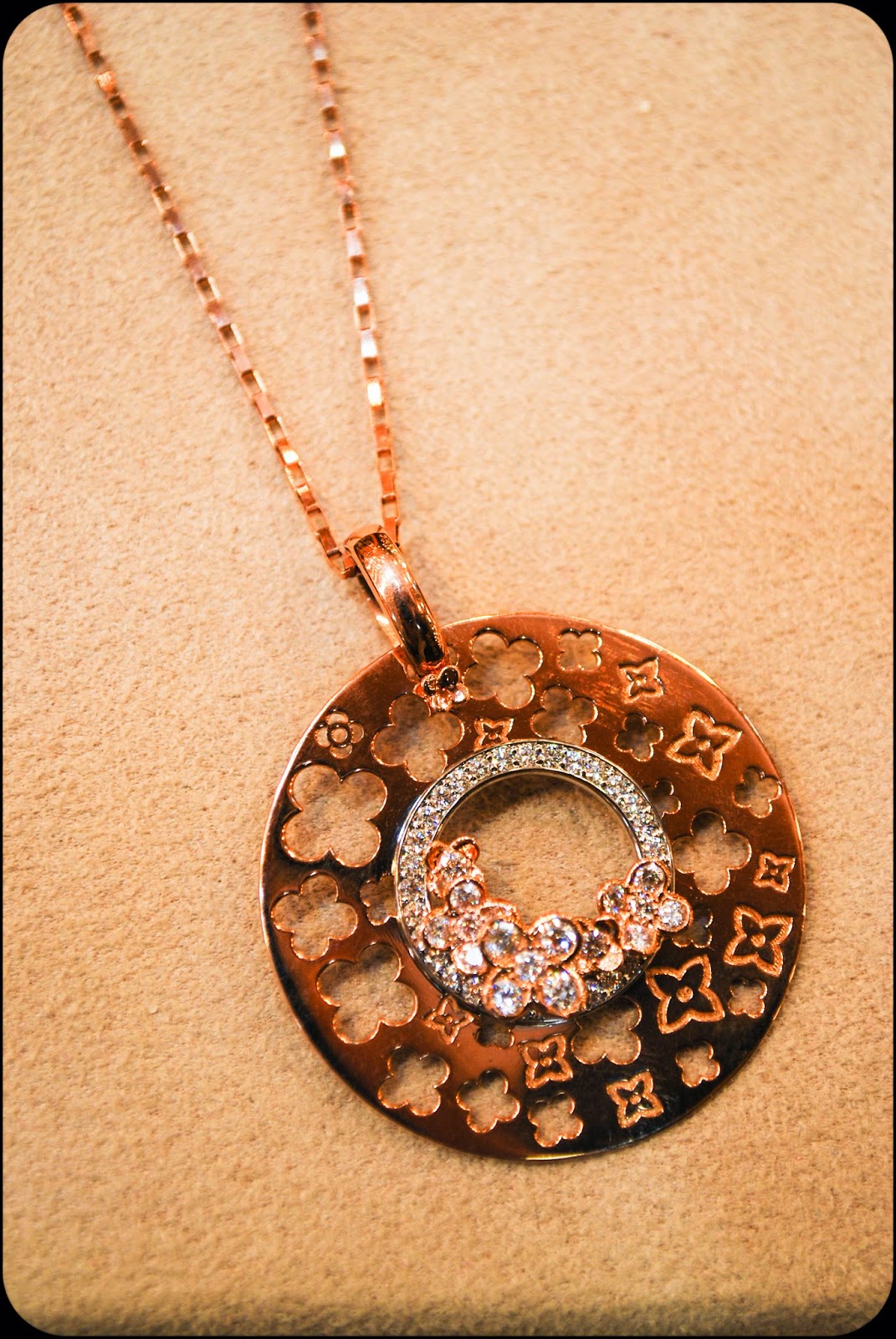
PINK/ROSE GOLD
Picture Courtesy: Sri Krishna Diamonds & Jewellery, Commercial Street, Bangalore
 
YELLOW GOLD


WHITE GOLD
Picture Courtesy: Sri Krishna Diamonds & Jewellery, Commercial Street, Bangalore
 

BLACK GOLD

 
Half of the world’s gold resources are in South Africa. Other major sources are in the United States of America, Brazil, Australia, Canada, China and Russia.

 
SILVER: 

Like gold, silver is also a prized metal for its beauty, usefulness and metallic bright luster. It is a medium heavy, ductile and malleable metal. On exposure to oxygen in the air, silver oxidizes and a black layer of silver oxide is formed on the surface. Silver is also a very soft metal to work with hence, it is alloyed with copper.

ALLOYS
% OF PURE SILVER
%OF OTHER METALS
Sterling silver
92.5
7.5% Copper
Britannia silver
95.8
4.2% Copper & Zinc

STERLING SILVER
 
Sterling silver is most widely used for kitchenware and cutlery. Britannia silver was introduced in Great Britain in 1697 by William III to limit the practice of melting and clipping sterling silver coinage.

One of the most important uses of silver is ‘soldering’. A solder is an intermediary non-ferrous alloy which in its molten state is able to join different or similar metals together. So, soldering can be defined as a process of joining metals with the use of solder and applying heat to the object.

There are three different kinds of solders:

TYPE
COMPOSITION
Hard solder
75% Silver + 15% Copper + 10% Zinc
Medium solder
70% Silver + 15% Copper + 15% Zinc
Easy Flow solder
65% Silver + 20% Copper + 15% Zinc


Important mining sources for silver include South America, United States of America, Australia and the former USSR. The finest silver is produced by Norway and the largest producer of Silver is Mexico.


PLATINUM:

Platinum got its name from the Spanish term Platina which means ‘little silver’. It has a grayish-white lustrous appearance and is more ductile than gold, silver and other metals. It is a dense metal and does not corrode which makes it fit for jewelry. The price for platinum is higher than gold because it is a very rare metal. Platinum is alloyed with copper and cobalt to increase its workability. In any alloy there should be at least 85% pure platinum.

PLATINUM
Picture Courtesy: Sri Krishna Diamonds & Jewellery, Commercial Street, Bangalore

Platinum experts state that 75% of the platinum in the world is produced by South Africa, 14% by Russia. The other producers are Zimbabwe, Canada and the United States of America.
 
 
To conclude, one would like to say that every metal is unique and working with it is an art in itself. So, take a plunge in these facts n figures and explore the interesting study of metals.

Thursday, 24 April 2014

Forms And Surfaces


After getting to know about the elements of design, the very next step is to understand the various metal forms and surfaces. An understanding of this subject will give your conceptualization an interesting edge.
I have an exercise for my readers to do… Take a few pieces of jewelry available with you and try to observe these pieces. While making an observation try and look for the following things-       

  • Is your piece of jewelry absolutely flat?
  • If yes, then how appealing it is to you? 
  • Look for a piece that has a little bit of a dome or a curved effect. Or something that has a combination of flat and dome.
  • Try and judge what seems to be more captivating.


Through this exercise what I intend to convey is that, while designing jewelry we need to use different forms to increase the appeal quotient of an ornament. A piece of jewelry that uses a couple of forms will definitely be more alluring than a flat piece of jewelry. One also has to understand that there is a lot of jewelry made with a flat form, depending on the kind of product being dealt with. For example wedding bands are usually fashioned in a flat form. And a lot depends on the demand of one’s clients.


FLAT SURFACE USED FOR WEDDING BANDS


There are different kinds of forms and surfaces that we can work with. To make it easily understandable I have tried to broadly divide them in the following categories-


I have illustrated the following forms. For a clear understanding it is very essential to know how light falls on these forms and surfaces. In all my illustrations I am assuming the light source to be top left, which is marked with an arrow. The dark shades indicate the areas where lesser light is falling on the object and vice versa. This will always help you in rendering which in return will make your design communicate well with the viewer and the craftsmen.


1.FLAT :A flat surface can be defined as an even or smooth plane with no depth, curve or tilt.


FLAT SURFACE

 2.DOME/CURVE: A curved object usually has a bent or a raised, smooth surface.


CURVED SURFACE


3.KNIFE- EDGE: This surface is marked by a very sharp and fine edge, like that of a wedge on which the

 plank of a see saw balances or oscillates.


KNIFE-EDGE SURFACE


4. SPHERE: .Sphere is perfectly round, three dimensional representation of a circle


SPHERE


5.    CONCAVE: This can be defined as a curved surface, like the interior of a hollow sphere.


CONCAVE SURFACE


6.CONE:  it is a three dimensional shape that has a round base and one vertex. It tapers evenly from the base to the vertex.
CONICAL SURFACE

Another aspect which I would like to touch upon here is that do not restrain your -self from using these forms in combination. Forms can produce remarkable results and can take your design to a new high.


USE OF FORMS TO CREATE JEWELRY
(CURVED SURFACE AND SPHERES)

There is a tip I would like to share with you. Whenever you are trying to develop a form or a complicated design, use a clay model (play dough) to make it. Shape the clay with your hands to give it the desired form. 

Also when you give a model like this to your craftsmen it is very easy for them to understand your design and for them to replicate it.

  You can develop your own interesting and unique forms and work with them. So, let your imaginative side take over and make best use of these forms.