Wednesday, 15 April 2015

Diamond Treatments


A diamond is one of the finest creations of nature. The precision with which these diamonds are formed in the core of the earth is admirable. But, these spectacular diamonds are often tainted with imperfections. These flaws are either in the form of color or clarity characteristics. Imperfections  which pertain to the color of the diamond is due to the impurities present in the gem or due to distortions in the crystal structure.  

Mostly, yellow or brown diamonds are treated to transform them into colorless diamonds. The yellow or brown tint is due to the presence of nitrogen. Similarly blue/greyish diamonds are also treated which owe their color to boron. On the other hand are the inadequacies in the clarity of a diamond. Treatments for clarity either conceal the flaws or remove them.

This post will talk about in detail the various treatments carried out on diamonds.

Treatments for color enhancement:
Irradiation: under this process the diamonds are exposed to radiation to alter their color. Radiation is a process of transmitting energy in the form of waves or particles. In the laboratories diamonds are bombarded with neutron or electron particles which causes distortions in the crystal system of a diamond. This distortion often results in beautiful colors. Common colors which irradiation produces are blue, green, yellow, orange and black. Irradiated diamonds are further heated at times to achieve particular colors. The treatment can be identified by gem testing labs.

 
IRRADIATED DIAMONDS
Coating:  it is a procedure in which thin films are applied on the diamond, specifically on the pavilion areas which affects the face up look of the diamond. This treatment can be stimulating for the gemologists to find out. The loop holes of this treatment are, when it is viewed under high magnification sometimes the air bubbles trapped between the diamond surface and film is visible and also if the coating has got scratched due to wear and tear, it is identifiable.

 
COATED DIAMONDS
High Pressure High Temperature: this is the most commonly used method for modifying the color of diamonds. This technique is applied mostly to Type 2A diamonds which usually have a yellowish or brown tint, to produce more marketable colorless diamonds. This treatment is equally challenging for the gemologists to identify.

 
HPHT TREATMENT
Treatment for clarity enhancement:
Laser Drilling: this procedure uses lasers to reach the inclusions in the diamond which have a negative impact on the visual appeal. Once the laser reaches the inclusion either it is bleached with acids or filled with substances that can conceal the inclusion. This treatment often leaves “drill-holes” which helps in identifying the treatment. These drill holes are basically tiny openings at the surface.

 
LASER DRILLED DIAMOND UNDER MAGNIFICATION
Fracture-Filling: feathers are one of the most common inclusions seen in the diamonds and they affect the appearance to a great extent. To improvise the appearance of the diamonds fractures are often filled high RI glass filling which makes it difficult for the gemologists to identify the treatment. But, in dark field illumination often the flash-effect can be noticed. Flash effect displays combination of colors like orange and blue, orange and yellow or sometimes pink and purple.
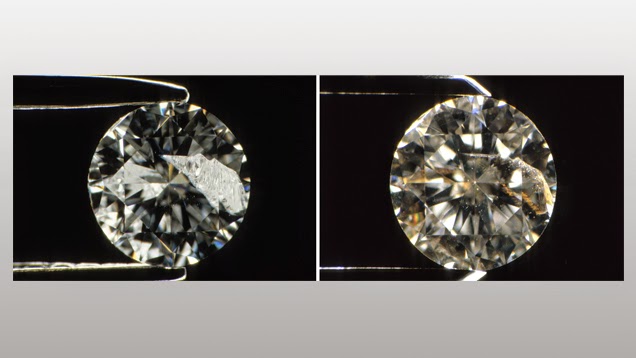
IMPROVED APPEARANCE OF A DIAMOND

FLASH-EFFECT IN A FRACTURE FILLED DIAMOND

Enhancement of gem material in todays’s time is a common affair, but what’s not common, is the disclosure. Disclosing a treatment will always prove to be beneficial for a trader. It not only instils confidence in the consumer, it even helps them understand the reason why the gem material was treated and how the treatment has made the gem more appealing and durable. Some treatments fade away with time, so it is the responsibility of the trader to inform the consumers about any such treatments. Ethical treatments and disclosure will always have a positive impact on the gem market and the end users.


Monday, 9 February 2015

Diamond Simulants


A diamond is one of the most sought after gem material. Its rarity and the process which brings it from mine to market usually makes it unaffordable for the masses. This particular reason has given a boost to the diamond simulants industry. Apart from this, with the introduction of fashion jewelry in the market the demand for simulants has only increased.

But, what is a simulant? A simulant can be described as a look-alike or imitation of any gem material and their physical properties, chemical properties and composition differ from the natural gemstone. Usually, synthetic gemstones are also termed as simulants but, it is incorrect to do so as synthetics are lab grown gem materials with identical physical and chemical properties along with the chemical composition of their natural counterpart.

This post takes up the most commonly used diamond simulants in the market.

Synthetic Cubic Zirconia – commonly known as american diamonds or cz,  are used very frequently to replace diamonds. This is by far the most profitable simulant with a visual appeal that is closest to a diamond. Coming down to the technical details, cz is a relatively hard material, scoring an eight on Moh’s scale of hardness.  Specific gravity of cz is higher than that of a diamond – 5.5.  High dispersion and specific gravity is a give away when it comes to differentiating between a diamond and synthetic cubic zirconia.
 
SYNTHETIC CUBIC ZIRCONIA

Synthetic Moissanite – this simulant has been a matter of concern for the gemologists because its properties are very close to that of a diamond. The biggest challenged posed by synthetic moissanite is that its thermal properties are very close to that of a diamond and when it is tested in a thermal conductivity tester the instrument recognises the simulant as diamond. The other pysical properties are also very close  to a diamond. The specific gravity of synthetic moissanite is 3.21 and it displays little more fire than diamond. The key factor that helps in separating it from a diamond is that synthetic moissanite is a doubly refractive gem, whereas diamond is singly refractive. When one observes the gem under a microscope doubling effect of the facet junctions can be noticed.
 
STRONG DOUBLING IN SYN. MOISSANITE

DIAMOND THERMAL CONDUCTIVITY TESTER


Synthetic Rutile – this synthetic gem material usually has a yellowish tint. It is a doubly refractive gem material with very strong doubling. Along with this synthetic rutile has high dispersion, or in other words it displays a strong fire. These two factors help in easily separating it from diamond. Synthetic rutile is also a more dense material than diamond with specific gravity of 4.26.
 
SYNTHETIC RUTILE

Strontium Titanate – this is another popular diamond simulant which is a singly refractive gem. With a poor hardness of 5 on the Moh’s scale of hardness it takes a poor polish and has high dispersion value.
 
STRONTIUM TITANATE
Others – there are many others simulants in the  market like glass, synthetic colorless sapphire and natural zircon. Besides these there are certain lab developed crystals like yittrium aluminium garnet (YAG) and gadolinium gallium garnet (GGG).

YAG

GGG

It is a fair practice to trade simulants if they are not sold with an intention to deceive the consumer. It is incomprehensible for a consumer with limited knowledge of gems and jewelry. Once mounted, it is even more strenuous to find out what the gem material exactly is. It needs an expert eye to identify these look-alikes. Therefore, it is always advised to buy certified diamonds for end consumers and for diamond dealers and retailers to be alert and have thorough knowledge which can prevent them from being swindled.


Thursday, 1 January 2015

Blood Diamonds


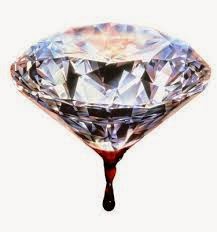
While looking at a diamond one  is captivated by its charm, its brilliance and its sparkle. The wearer  is often mesmerised by the perfection of the facets and the fire of a diamond, but the picture is not always so beautiful.  In some parts of the world diamonds are used to finance wars and illegal operations. These diamonds are often termed as blood diamonds or conflict diamonds.
 
BLOOD DIAMONDS


The United Nations define blood diamonds as-" Diamonds that originate from areas controlled by forces or factions opposed to legitimate and internationally recognised governments, and are used to fund military action in opposition to those governments, or in contravention of the decisions of the Security Council. "


The illegitimate sale of conflict diamonds has produced millions of dollars to fund civil wars if African countries like Angola, Democratic Republic of Congo, Sierra Leone and Liberia. The concept of conflict diamonds started taking shape years ago in African countries when certain traders discovered that they could earn huge profits by smuggling them out of the country. This gave rise to illegal mining and selling of diamonds. Eventually, the trade of conflict diamonds flourished and the governments of the respective nations failed to police these illegal operations.

Sierra Leone is one country which witnessed one of the most brutal wars in the history of mankind. Soon after Sierra Leone gained independence from Great Britain in 1961, smuggling of diamonds was a serious concern. The government here turned out to be corrupt and it encouraged illicit trade. In 1991 a rebel group called the Revolutionary United Front ( a group of rebels from Sierra Leone and Liberia) attacked eastern parts of the nation. These attacks were carried out in order to gain total control of the diamond mines and overthrow the existing government. The civil war here lasted for nine years and the war was funded by exchanging diamonds for weapons. A peace treaty was signed by the RUF with the government but rebel groups still continue to terrorise this country. However, this civil war devastated Sierra Leone. Poor economy and  social instability, left the country torn apart. The RUF has committed unjustifiable crimes like amputation and mutilation, sexually assaulted women, murders etc.

FORCED LABOUR IN SIERRA LEONE

REBEL GROUPS

Similarly after Angola gained independence from Portugal, a civil war broke out between two prominent political parties of the country. Reason being the same , whoever controls the diamond mines, controls the nation. Likewise, Zimbabwe has also been stained with the bloods of many to carry on the smuggling of Marange diamonds which is capable of producing 40 million carats of diamonds every year.  The authorities captured the diamond producing areas and they make the miners work under inhuman conditions.
 
AMPUTATION OF LIMBS BY REBEL GROUPS

According to a speculation, a lot of these diamonds from Zimbabwe and other African countries are sent to the diamond cutting and polishing hub of India, Surat. Due to availability of cheap labour and not - so - strict regulations these diamonds easily flow into the Indian market. And from India to other countries like US and Canada. Once they step into the Indian market it is very difficult to trace their origin. Antwerp, which is the world leader in cutting and polishing of diamonds has maintained strict regulations on the flow of these tainted diamonds and hence it helps in controlling the movement of these diamonds.

In the context of blood diamonds it has been rightly said that, diamonds resources are usually a boon for any country but, for these African countries they have proved out to be their biggest curse.

However, the United Nations, De Beers, Diamond Council and various human rights organisations are taking up measures to control the movement conflict diamonds. The most concrete step taken in this direction is the Kimberley Certification Scheme which was launched by De Beers in the year 2003. Under this scheme the rough diamonds have to be a accompanied with a certificate of origin. These rough diamonds should not be  funding any illegitimate operations against a UN recognised government and diamonds cannot be exported to or imported from a non member of the scheme. This prevents blood diamonds from entering the conventional rough diamond market. Besides this, it also prevents the buyer from unknowingly funding an illicit operation and encouraging inhumane activities.

CERTIFICATE OF ORIGIN

CERTIFICATION FOR EXPORTATION OF ROUGH DIAMONDS


As a consumer, one can always ask for a certificate of origin from the seller to ensure that diamonds purchased are from conflict free areas. A genuine certificate of origin is what helps one to differentiate between a conflict diamond and legitimate diamond.

KIMBERLEY PROCESS CERTIFICATE


Diamonds symbolise eternal love,  they should not be tainted with  the blood of innocent people. Hence, one should make sure that diamonds being bought are responsibly sourced so that directly or indirectly we are not funding any violent operations.