Monday, 9 February 2015

Diamond Simulants


A diamond is one of the most sought after gem material. Its rarity and the process which brings it from mine to market usually makes it unaffordable for the masses. This particular reason has given a boost to the diamond simulants industry. Apart from this, with the introduction of fashion jewelry in the market the demand for simulants has only increased.

But, what is a simulant? A simulant can be described as a look-alike or imitation of any gem material and their physical properties, chemical properties and composition differ from the natural gemstone. Usually, synthetic gemstones are also termed as simulants but, it is incorrect to do so as synthetics are lab grown gem materials with identical physical and chemical properties along with the chemical composition of their natural counterpart.

This post takes up the most commonly used diamond simulants in the market.

Synthetic Cubic Zirconia – commonly known as american diamonds or cz,  are used very frequently to replace diamonds. This is by far the most profitable simulant with a visual appeal that is closest to a diamond. Coming down to the technical details, cz is a relatively hard material, scoring an eight on Moh’s scale of hardness.  Specific gravity of cz is higher than that of a diamond – 5.5.  High dispersion and specific gravity is a give away when it comes to differentiating between a diamond and synthetic cubic zirconia.
 
SYNTHETIC CUBIC ZIRCONIA

Synthetic Moissanite – this simulant has been a matter of concern for the gemologists because its properties are very close to that of a diamond. The biggest challenged posed by synthetic moissanite is that its thermal properties are very close to that of a diamond and when it is tested in a thermal conductivity tester the instrument recognises the simulant as diamond. The other pysical properties are also very close  to a diamond. The specific gravity of synthetic moissanite is 3.21 and it displays little more fire than diamond. The key factor that helps in separating it from a diamond is that synthetic moissanite is a doubly refractive gem, whereas diamond is singly refractive. When one observes the gem under a microscope doubling effect of the facet junctions can be noticed.
 
STRONG DOUBLING IN SYN. MOISSANITE

DIAMOND THERMAL CONDUCTIVITY TESTER


Synthetic Rutile – this synthetic gem material usually has a yellowish tint. It is a doubly refractive gem material with very strong doubling. Along with this synthetic rutile has high dispersion, or in other words it displays a strong fire. These two factors help in easily separating it from diamond. Synthetic rutile is also a more dense material than diamond with specific gravity of 4.26.
 
SYNTHETIC RUTILE

Strontium Titanate – this is another popular diamond simulant which is a singly refractive gem. With a poor hardness of 5 on the Moh’s scale of hardness it takes a poor polish and has high dispersion value.
 
STRONTIUM TITANATE
Others – there are many others simulants in the  market like glass, synthetic colorless sapphire and natural zircon. Besides these there are certain lab developed crystals like yittrium aluminium garnet (YAG) and gadolinium gallium garnet (GGG).

YAG

GGG

It is a fair practice to trade simulants if they are not sold with an intention to deceive the consumer. It is incomprehensible for a consumer with limited knowledge of gems and jewelry. Once mounted, it is even more strenuous to find out what the gem material exactly is. It needs an expert eye to identify these look-alikes. Therefore, it is always advised to buy certified diamonds for end consumers and for diamond dealers and retailers to be alert and have thorough knowledge which can prevent them from being swindled.


Thursday, 1 January 2015

Blood Diamonds


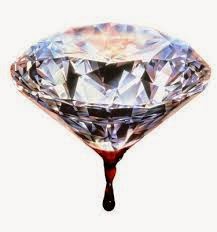
While looking at a diamond one  is captivated by its charm, its brilliance and its sparkle. The wearer  is often mesmerised by the perfection of the facets and the fire of a diamond, but the picture is not always so beautiful.  In some parts of the world diamonds are used to finance wars and illegal operations. These diamonds are often termed as blood diamonds or conflict diamonds.
 
BLOOD DIAMONDS


The United Nations define blood diamonds as-" Diamonds that originate from areas controlled by forces or factions opposed to legitimate and internationally recognised governments, and are used to fund military action in opposition to those governments, or in contravention of the decisions of the Security Council. "


The illegitimate sale of conflict diamonds has produced millions of dollars to fund civil wars if African countries like Angola, Democratic Republic of Congo, Sierra Leone and Liberia. The concept of conflict diamonds started taking shape years ago in African countries when certain traders discovered that they could earn huge profits by smuggling them out of the country. This gave rise to illegal mining and selling of diamonds. Eventually, the trade of conflict diamonds flourished and the governments of the respective nations failed to police these illegal operations.

Sierra Leone is one country which witnessed one of the most brutal wars in the history of mankind. Soon after Sierra Leone gained independence from Great Britain in 1961, smuggling of diamonds was a serious concern. The government here turned out to be corrupt and it encouraged illicit trade. In 1991 a rebel group called the Revolutionary United Front ( a group of rebels from Sierra Leone and Liberia) attacked eastern parts of the nation. These attacks were carried out in order to gain total control of the diamond mines and overthrow the existing government. The civil war here lasted for nine years and the war was funded by exchanging diamonds for weapons. A peace treaty was signed by the RUF with the government but rebel groups still continue to terrorise this country. However, this civil war devastated Sierra Leone. Poor economy and  social instability, left the country torn apart. The RUF has committed unjustifiable crimes like amputation and mutilation, sexually assaulted women, murders etc.

FORCED LABOUR IN SIERRA LEONE

REBEL GROUPS

Similarly after Angola gained independence from Portugal, a civil war broke out between two prominent political parties of the country. Reason being the same , whoever controls the diamond mines, controls the nation. Likewise, Zimbabwe has also been stained with the bloods of many to carry on the smuggling of Marange diamonds which is capable of producing 40 million carats of diamonds every year.  The authorities captured the diamond producing areas and they make the miners work under inhuman conditions.
 
AMPUTATION OF LIMBS BY REBEL GROUPS

According to a speculation, a lot of these diamonds from Zimbabwe and other African countries are sent to the diamond cutting and polishing hub of India, Surat. Due to availability of cheap labour and not - so - strict regulations these diamonds easily flow into the Indian market. And from India to other countries like US and Canada. Once they step into the Indian market it is very difficult to trace their origin. Antwerp, which is the world leader in cutting and polishing of diamonds has maintained strict regulations on the flow of these tainted diamonds and hence it helps in controlling the movement of these diamonds.

In the context of blood diamonds it has been rightly said that, diamonds resources are usually a boon for any country but, for these African countries they have proved out to be their biggest curse.

However, the United Nations, De Beers, Diamond Council and various human rights organisations are taking up measures to control the movement conflict diamonds. The most concrete step taken in this direction is the Kimberley Certification Scheme which was launched by De Beers in the year 2003. Under this scheme the rough diamonds have to be a accompanied with a certificate of origin. These rough diamonds should not be  funding any illegitimate operations against a UN recognised government and diamonds cannot be exported to or imported from a non member of the scheme. This prevents blood diamonds from entering the conventional rough diamond market. Besides this, it also prevents the buyer from unknowingly funding an illicit operation and encouraging inhumane activities.

CERTIFICATE OF ORIGIN

CERTIFICATION FOR EXPORTATION OF ROUGH DIAMONDS


As a consumer, one can always ask for a certificate of origin from the seller to ensure that diamonds purchased are from conflict free areas. A genuine certificate of origin is what helps one to differentiate between a conflict diamond and legitimate diamond.

KIMBERLEY PROCESS CERTIFICATE


Diamonds symbolise eternal love,  they should not be tainted with  the blood of innocent people. Hence, one should make sure that diamonds being bought are responsibly sourced so that directly or indirectly we are not funding any violent operations.


Saturday, 29 November 2014

Diamond Formation

The glitter of diamonds, the perfection of their facets and their scintillating fire always makes one wonder that how did these shining beauties come to existence? Diamonds are formed under certain precise conditions in the deep interiors of the earth. These sparkling fruits of nature are believed to be more than billions of years old and form under the stable continental plates. In this post we will unearth the procedure of diamond formation.


The formation of diamonds takes place under extreme conditions. Diamonds form mostly in the mantle which is below the surface layer of the earth at a distance of approximately 150 Kms. When carbon crystals are subjected to a temperature of 1050° C and a pressure of 45000-60000 Kilobars, is when the process of diamond formation begins. These conditions are not present uniformly in the layers of the earth. These conditions mostly exist under the stable continental plates. These stable parts are called cratons.
 
CRATONS

It is a fairly common belief that when a person or an object is subjected to immense pressure and difficulties they either they crack or come out victorious. The same is with the diamonds they undergo extreme heat and pressure in the interiors of  the earth but a slight change in the conditions can lead to formation of graphite.
 
GRAPHITE

There are two types of diamonds – P Type and E Type. P type diamonds are formed with the help of peridotitic rocks and E type are formed with the assistance of eclogitic rocks.  Peridotite and eclogite are referred to as source rocks as the diamonds form in these igneous rocks. These rocks exist under the earth in a molten state and they continuously emit carbon. The carbon atoms under the immense heat and pressure of the earth’s interiors start locking with each other. If the conditions are accurate diamond crystals start forming.
PERIDOTITE

Diamonds formed in the mantle are brought up to earth’s surface by the deep volcanic eruptions. These eruptions break the mantle and bring the diamonds to the surface. The rocks which transport the diamonds are kimberlite and lamproite. Kimberlite and lamproite are formed in the molten magma in the mantle.  The magma expands as it heats up and it passes through a fracture in the crust. While passing through a fracture it might come in contact with a diamond deposit and carry the diamonds along with it. The magma then continues to rise and the pressure decreases. With the decrease in pressure magma is able to travel at a very high speed of about 300 Kms/hour. At this stage some chemicals start to vaporise into carbon dioxide and water vapour. The speed of magma along with release of gases leads to an explosion. At this very point kimberlite pipes are formed. These pipes are where the majority of diamonds are found.
 
KIMBERLITE PIPE

Any change in vaporisation and the speed of magma can result in formation of graphite. The kimberlite or lamproite then solidifies creating a diamond rich deposit. This is what most of the diamond miners hunt for.

Diamonds go through a lot before one sees them glittering in a store’s display. They undergo extreme heat and pressure and are brought to the earth by violent eruptions. For years together they trapped there until unearthed by man. Thereafter, they are cut and polished and that’s when one sees the real beauty of diamonds.  And that is why it is said, to have an understanding of diamond formation is extremely important not only from technical aspects but also because so that one can appreciate this unique process and also how rare are fine gem quality diamonds.